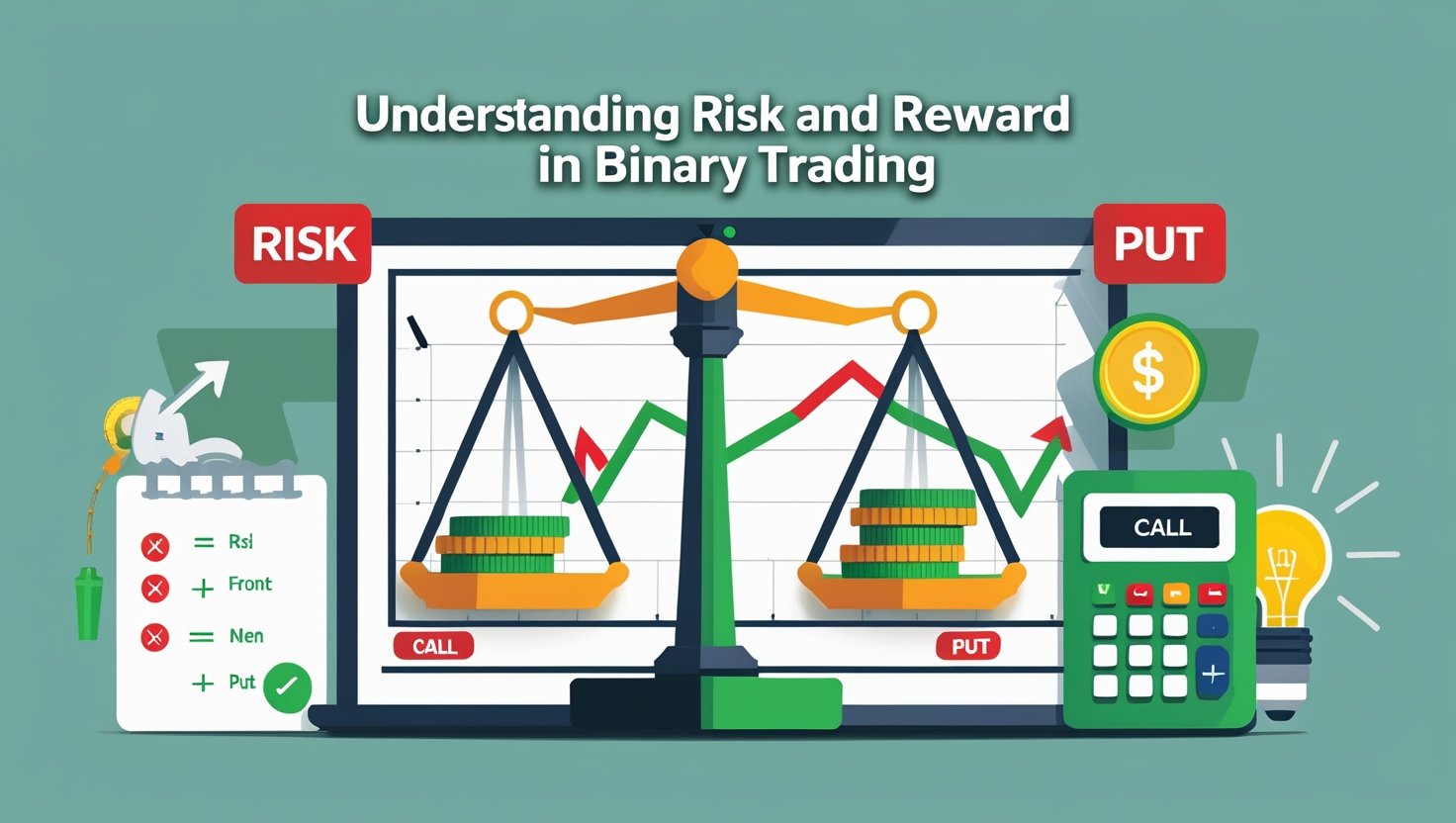
In binary trading, the concept of risk and reward is the first and most important one that every trader must understand. In this field, you predict the price movement of an asset in a short time frame, and on winning or losing, there is a fixed payout or a total loss. This sounds simple, but in reality, it is very important to understand the risk and reward in this. Often, beginners start trading just by looking at the reward, but without understanding the risk, they very soon lose their money. Therefore, it is important to understand how much risk is involved in each trade and how much reward can be obtained in comparison to that. In this introduction, we highlight that, unlike traditional trading, in binary options, you get a fixed payout, but if the prediction is wrong, then the whole amount is lost.
This is a high-risk, high-reward setup that demands discipline and the right strategy. Often, people think of it as gambling and invest money without a plan, and then, after the loss, blame the market that the market is not fair. But in reality, it can be profitable if you control the risk and have realistic reward expectations. The purpose of this guide is to help you understand that without balancing risk and reward, a sustainable profit can never be made. That is why it is important to seek it out from the very beginning and implement it in your trading.
What Does ‘Risk’ Mean in Binary Trading?
Risk in binary trading means the possibility that you can lose your invested amount in any trade. There is no partial loss; either you win or the entire amount is lost. This factor makes binary options different from other trading forms. To understand risk, you need to look at market volatility, asset behavior, and expiry time. Even small price changes during short expiry times can cause you a loss. For example, if you think that the price will go up but the market makes a slight opposite move, you will still lose all your money.
Beginners often underestimate this risk. Risk should always be taken after calculating it, and never invest a large portion of the total account balance in a single trade. Apart from this, another way to understand risk is to analyze your past trades and see which type of trades you lose more. This will help you find out about your mistakes. Only after understanding the risk can you make a correct trading plan. Market news and sudden events also increase the risk factor, so one should always check the economic calendar. Unless you have an idea of the risk, you can never survive in binary trading.
Understanding ‘Reward’ in Binary Trading:
In binary trading, a reward means the fixed return that you get when your prediction is correct. This reward percentage can be from 60% to 95% depending on the broker, asset, and market conditions. Meaning if you invest 100 dollars and the payout is 80%, then if you win, you will get 180 dollars; otherwise, the entire 100 dollars will be lost. The advantage of this fixed reward is that you know in advance how much you will get on winning, but the problem with this is that if you win one trade and lose the next trade, you can go into an overall loss.
Therefore, it is important to understand the reward as it is always profitable for you when you’re winning trades are more than your losing trades. Beginners often invest big amounts, seeing the high payout, but ignore the risk. The way to maximize reward is to trade in low-risk setups and invest only in strong signals. Each payout percentage should be compared so that you get the best value. Creating a trading journal and recording each payout also helps you understand your reward system.
The Risk-Reward Ratio – How to Calculate It:
The risk-reward ratio is a formula every trader should know. This ratio means how much you risk in each trade and how much reward you expect in comparison to that. In binary trading, the risk-reward ratio is simple because your risk is always your invested amount, and the reward is a fixed payout. For example, if you invest $50 and the payout is 80% then your risk is $50 and the reward is $40. Its ratio is 1:0.8, which shows how much you are getting in comparison to the risk you are taking in each trade.
Often, traders ignore this ratio and focus only on the payout. But if you consistently make such trades where the payout is low and your win rate is low, you incur losses. You can improve your winning probability and profit sustainability only by understanding the risk-reward ratio. To calculate this ratio, you should look at your average win and loss amounts and then plan how many trades you need to win. The ratio can be modified in forex and stocks, but in binary options, it is fixed and hence depends more on accuracy and timing.
Factors That Influence Risk and Reward:
Many factors in binary trading directly affect your risk and reward. The first factor is the choice of asset. High volatility assets like forex pairs or crypto offer more risk and more reward. The second factor is the expiry time. Short expiry trades offer high risk because even a small price move can make you lose, while in long expiry, you get more time to understand the price direction. Market conditions and economic news also have a huge impact. If any major news comes, the market can move unpredictably.
The second factor is the payout policy of the broker. Every broker has different payout rates, which directly affect the reward. The trader’s psychology is also an important factor. If you are impulsive or take decisions out of greed, your risk is eliminated. Apart from this, your strategy and indicators also decide whether you are choosing low-risk setups or high-risk ones. You should always analyze your trading style and market conditions so that you can understand which factors are more beneficial for you. With this understanding, you can plan your trades more smartly and gain consistent rewards.
Strategies to Manage Risk and Maximize Reward:
Every beginner should learn some basic strategies to manage risk and maximize reward. The first strategy is to never invest a large amount in a single trade. Often, experts recommend investing only 1-2% of the account in a single trade. The second strategy is to practice on a demo account first so that you understand the signals and do not risk real money. It is very important to avoid overtrading because making too many trades weakens your decision-making. Another good strategy is to pick only high probability trades and analyze the market all the time.
Following the trend and trading at strong support-resistance levels is also a safe way. Another strategy is to analyse your mistakes after each trade and maintain a trading journal. When you know at which point you made a mistake, you can avoid it in the next trade. Choosing a reliable broker is also a part of the strategy, as low payout brokers limit your reward. Ultimately, patience and emotional control are most important, which help you maintain consistent profit and balanced risk-reward.
Common Pitfalls When Chasing Reward:
Binary trading beginners often make mistakes just because they are looking for high rewards and end up making their capital go down to zero. The first mistake is taking risky trades because of high payout offers. Every broker who promises unrealistic payouts or guaranteed profit is either a scam or makes you overtrade. The second mistake is over-leveraging or placing all-in trades where you put the entire balance in a single trade for a high reward.
Often, traders become overconfident after winning one or two trades and then end up incurring huge losses. People also trust fake signals or bots, which mostly lead to losses. Beginners think that the more money they invest, the more profit they will make, but without proper analysis, this strategy fails. While chasing rewards, people get involved in emotional trading and do not follow the plan. The solution to this is to have realistic reward expectations, have a correct trading plan, and keep a fixed risk amount on every trade. The biggest pitfall is to double trade to recover every loss. Only by avoiding this mistake can you make sustainable profits.
Conclusion:
This guide concludes that success in binary trading is possible only when you learn to balance risk and reward. Never think of it as a shortcut or gambling. Always keep realistic targets and work with patience. Start with small amounts and develop the right strategy by practicing on a demo account. Choose a reliable broker, keep an eye on economic news, and invest only in strong setups. It is very important to follow risk management rules and avoid emotional trading. Analyzing your results and keeping a journal after each trade helps you understand where you are strong and where you can do better.
You should know how much risk there is in every trade and how much reward will be received in comparison to that. This balance is the formula for long-term trading success. Without this balance, no matter how much you invest, you will incur a loss in the end. That is why every new trader should make it a habit to do every trade with a plan and calculated risk. Only then can you become a consistent and responsible trader who can survive in the market.
FAQs:
1. What does ‘risk’ really mean in binary trading?
In binary trading, ‘risk’ means the full possibility of losing the entire amount you invested in a trade. Unlike other trading types where you might have partial losses, binary trading has only two outcomes: either you win the fixed payout, or you lose all the money you placed on that trade. Risk also depends on market volatility, expiry time, and unexpected news events, which can all cause price movements against your prediction. Understanding this helps traders make smarter and more cautious decisions.
2. How do I calculate the risk-reward ratio in binary trading?
The risk-reward ratio in binary trading is quite straightforward because your risk is always the invested amount, and your reward is the payout you receive if your prediction is correct. For example, if you invest $50 and the payout is 80%, then your risk is $50, and your reward is $40. This makes the ratio 1:0.8. Keeping track of this ratio helps traders plan how many winning trades they need to stay profitable, rather than just focusing on payout percentages alone.
3. What factors can increase or decrease my risk and reward?
Several factors directly affect risk and reward: the type of asset you choose (high volatility assets like cryptocurrencies carry higher risk and higher reward), the trade’s expiry time (short expiry increases risk), market conditions, and economic news that can cause sudden price moves. The broker’s payout policies also affect reward, and a trader’s own psychology—like impatience or overconfidence—can raise risk unnecessarily.
4. What strategies can beginners use to manage risk while maximizing reward?
Beginners should start by investing only small amounts (1–2% of their account per trade), always practice on a demo account first, and avoid overtrading. Trading only on strong signals or clear trends, using support-resistance analysis, and reviewing every trade in a journal also helps. It’s also wise to choose brokers with fair payout rates and to stick strictly to a trading plan to keep emotions under control.
5. What are common mistakes beginners make when chasing higher rewards?
Common pitfalls include taking very risky trades just for high payout offers, over-leveraging or going “all in,” becoming overconfident after a few wins, and trusting fake bots or signals promising guaranteed profits. Beginners often ignore proper analysis and risk management, thinking bigger investments will bring bigger profits, but this usually leads to losses. Emotional trading, like doubling up after losses to recover quickly, is another frequent mistake that can wipe out accounts. The safest approach is always realistic reward expectations and disciplined trading.